

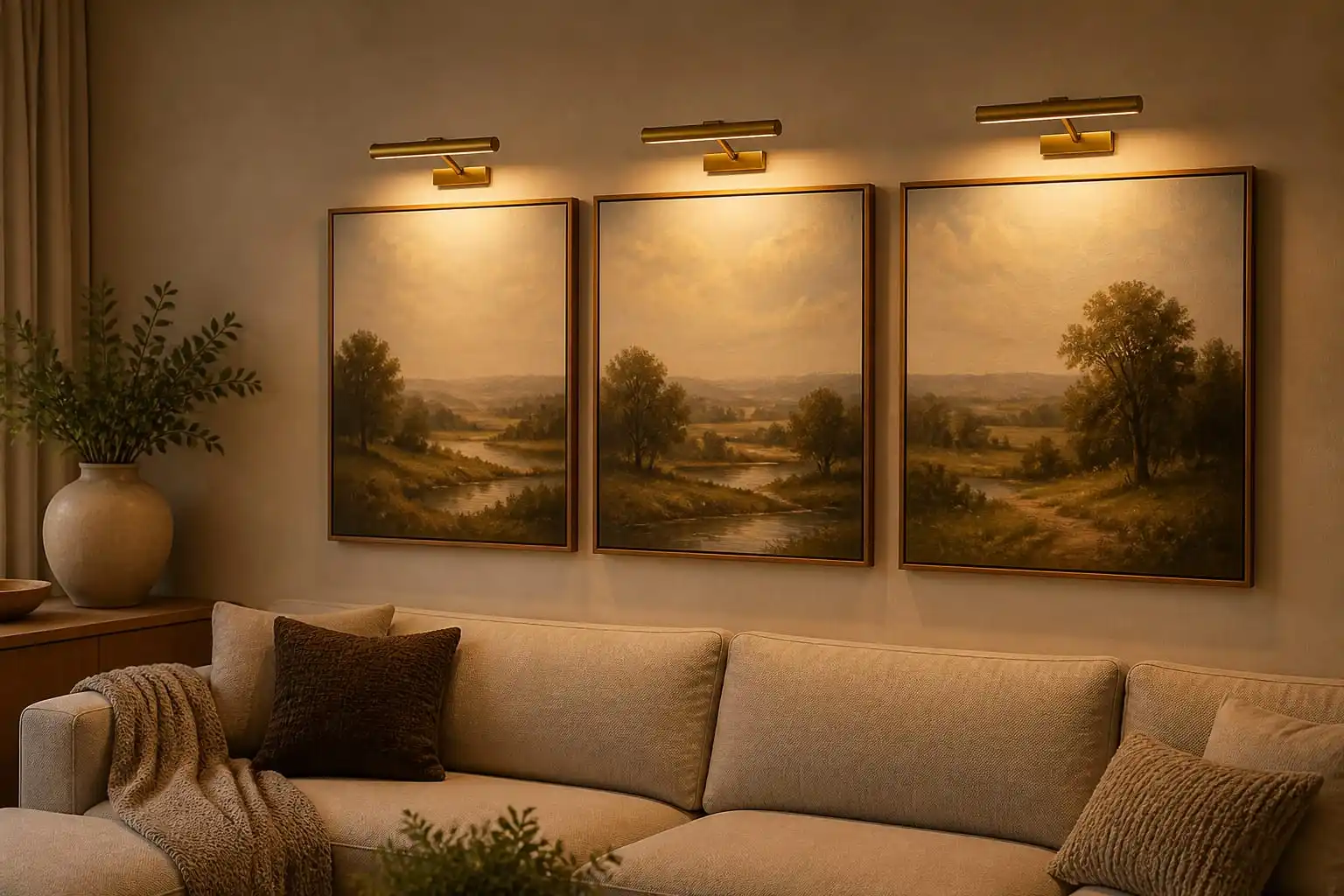
Triptych art prints, side-by-side diptychs, and expansive multi-frame gallery walls have become the gold standard for styling blank walls above sofas, dining credenzas, and long hallways. To illuminate these multi-piece displays, Amazon shoppers frequently turn to 2-pack and 3-pack picture light bundles. Yet, styling multiple light fixtures across one wall introduces design and technical nuances that single-light setups never face.
How do you ensure all lights turn on together without juggling multiple remotes? How do you prevent three separate light sources from turning your living room into an uncomfortably bright runway? And how do you maintain a clean, wire-free aesthetic when multiple fixtures need charging?
In this guide, we break down the essential rules of multi-light coordination—covering spacing geometry, unified remote syncing, lumen management, and batch maintenance for a flawless gallery wall.
1. Spacing & Rhythm: Sizing and Centering Across Multiple Frames
When hanging a 2-piece or 3-piece art series, the spacing between your frames should remain between 3 and 6 inches. For picture lights, follow these spatial rules:
- Individual Centering: Center each picture light directly over each individual frame, rather than trying to span a single oversized light across multiple smaller pieces. Individual fixtures create a rhythmic, museum-curated cadence.
- Uniform Lamp Width: Each light bar should span approximately 50% to 70% of its corresponding frame's width.
- Consistent Height: Mount all wall brackets at the exact same vertical distance above the top moulding (typically 4 to 6 inches) to maintain a crisp, horizontal sightline across the entire wall.
2. Unified Remote Control: One-Click Synchronization
Nothing ruins the luxury of an illuminated gallery wall faster than having to walk up to three separate frames to turn on manual switches, or aiming three different infrared remotes at different angles.
The Seediq Model 270 Wireless Picture Light utilizes a unified 2.4G remote system. With a single click from your sofa, all fixtures across your wall turn on, switch color temperatures, or dim in perfect synchronization.
3. Lumen Management & Smooth Dimming: Preventing Light Overload
A single picture light produces between 200 and 300 lumens—ideal for one statement piece. But when you install two or three units side-by-side, you are suddenly introducing 600 to 900 lumens of direct light onto one wall. At full output, this can easily overwhelm a cozy evening living room.
The key to multi-light elegance is dimming. Keep your multi-pack fixtures set to 30%–50% brightness during evening hours. This creates an intimate, glowing ambiance that highlights the artwork's brushstrokes without competing with your room's ambient mood lighting.
4. Color Temperature Harmony & Museum CRI 90+
When multiple lights operate side-by-side, even minor color variations become instantly noticeable. If one lamp is slightly cooler or lower quality than its neighbor, your gallery wall will look mismatched and disjointed.
Every Model 270 fixture is engineered with studio-grade LEDs featuring CRI 90+ color rendering and precision-binned color temperatures (2700K Warm, 4000K Neutral, and 6000K Daylight). Whether you style two frames in a bedroom or three in a formal dining room, every pigment and canvas texture renders with identical, true-to-life brilliance.
5. Batch Maintenance: The Magnetic Quick-Release Advantage
Managing multiple wireless devices shouldn't feel like a chore. The Model 270 connects to its wall mount via ultra-strong discrete magnets. When recharging is needed after weeks of use (offering up to 80 hours of runtime per charge), simply lift each lightweight wand off the wall with one hand.
You can recharge all units simultaneously on a single charging station, then snap them back into place in seconds—with zero re-alignment or wall damage required.
Elevate Your Multi-Piece Gallery Display
Synchronize your art display with antique brass craftsmanship, unified remote control, and museum-grade CRI 90+.
Shop the Model 270 Wireless Light