
The rise of Japandi, organic modernism, and warm minimalist interiors has transformed wall decor. Flat framed prints are increasingly sharing the spotlight with tactile, dimensional statement pieces—from sculptural textured plaster canvases and heavy impasto oil paintings to acoustic wood slat panels and woven fiber relief art. While these tactile artworks add unmatched depth and sensory warmth to living spaces, illuminating them presents a unique challenge. Standard overhead ceiling fixtures cast flat, unflattering illumination that washes out subtle relief details, while harsh directional floodlights create severe, distracting shadows. Mastering textured wall art lighting requires an understanding of angle, beam diffusion, and color rendering to reveal every sculptural contour without compromising the artwork’s organic charm.
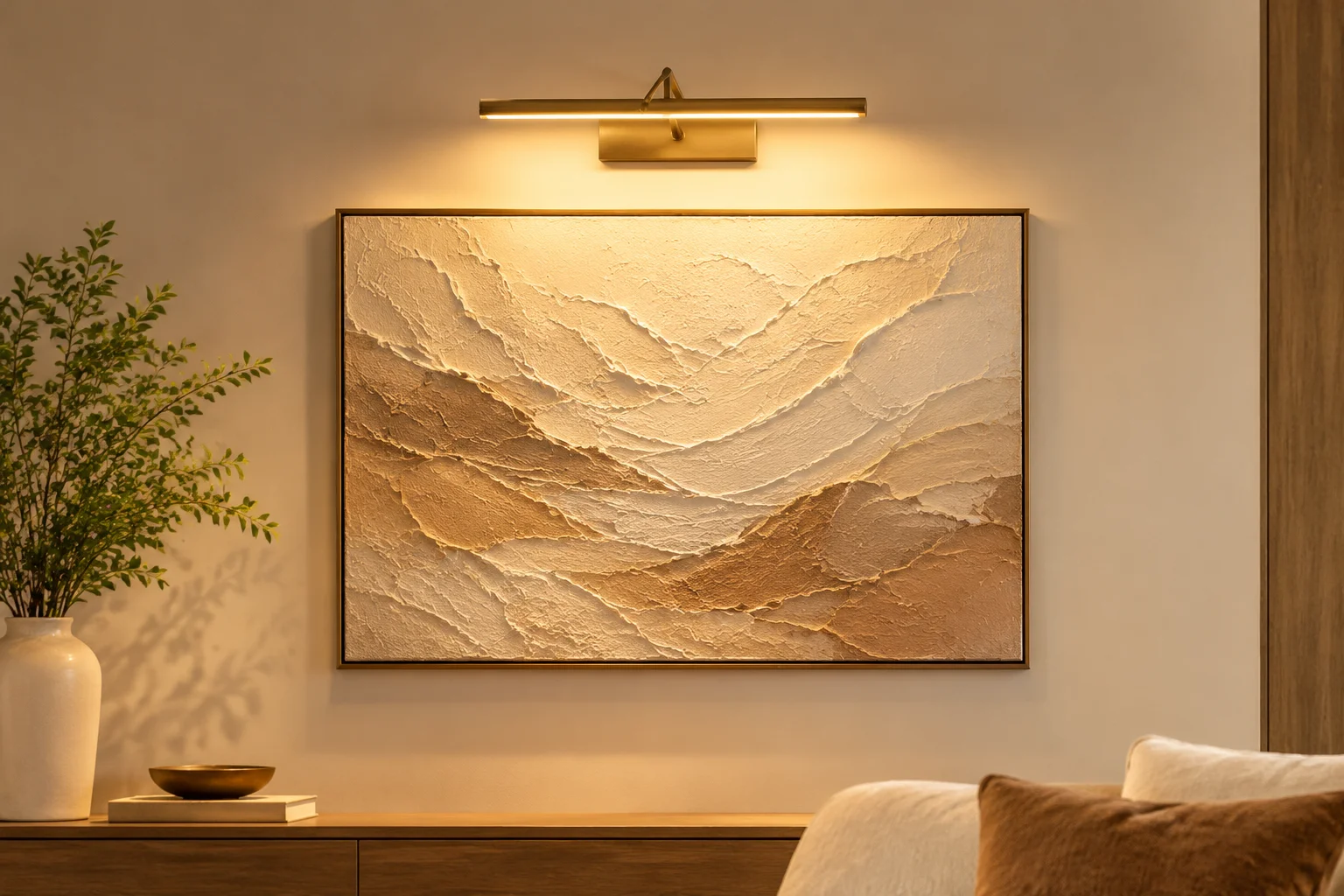
The Physics of Lighting 3D Art: Why Grazing Light Matters
Unlike two-dimensional photographs or glass-framed lithographs, textured art relies on subtle micro-shadows to convey its form and emotion. In museum curation, professionals utilize a technique known as raking light or surface grazing. By positioning a dedicated light source slightly above the top edge of the piece and angling it downward across the face, light gently catches the raised plaster ridges while casting soft, elongated gradients into the recessed valleys.
When light hits a 3D surface from directly in front—such as from a central living room chandelier or flush-mount ceiling light—the absence of shadow flattens the texture completely, making a handcrafted $800 plaster relief look like a flat matte poster. Conversely, an adjustable slim-profile wireless picture light allows you to fine-tune the illumination angle to create the perfect balance between bright textural highlights and soft ambient depth.
Color Temperature and CRI: Preserving Earthy Textures & Pigments
Textured and relief art often celebrates neutral, organic palettes—warm travertine, limestone beige, raw linen, terracotta, and soft charcoal. Lighting these pieces with generic 5000K “daylight” LEDs will strip them of their warmth, casting an icy, clinical blue hue over natural materials.
For organic modern art, a warm color temperature of 2700K to 3000K delivers an inviting, gallery-grade atmosphere. Equally important is the Color Rendering Index (CRI). Standard consumer LEDs typically feature a CRI rating of 70 to 80, which fails to reproduce subtle earthy undertones accurately. To ensure that your cream plaster or subtle ochre pigments appear rich and natural, always choose lighting fixtures engineered with a CRI of 90+. To learn more about how spectral accuracy impacts artwork display, read our comprehensive guide on What is CRI and Why High Color Fidelity Protects Your Art.
Mounting Height and Distance: Avoiding Harsh Hot Spots
When mounting a picture light over textured artwork, proper clearance is essential:
- Vertical Placement: Position the mounting base 5 to 7 inches above the top edge of the canvas or frame. Mounting too close produces a harsh concentrated “hot spot” on the upper 10% of the art, leaving the bottom in darkness.
- Horizontal Projection: Choose a fixture with an extending arm that holds the light tube 6 to 8 inches away from the wall. This projection angle allows the light beam to disperse evenly across the entire vertical surface.
- Width Proportions: As a rule of thumb, the picture light should span approximately one-half to two-thirds the total width of the artwork (e.g., a 16-inch light bar for a 24- to 32-inch wide canvas). For extra-wide oversized pieces (48+ inches), pairing two coordinated units creates balanced symmetrical coverage.
Finish Selection: Pairing Metal Tones with Textured Artwork
The fixture itself should complement the texture and frame aesthetic. If your piece features warm travertine tones, raw wood, or linen backgrounds, a brushed brass picture light adds a touch of mid-century sophistication and warmth. For monochromatic plaster art, dark academia palettes, or industrial concrete walls, a matte black slim-profile fixture delivers clean, architectural contrast.
The Cordless Freedom: Museum Quality Without Drywall Damage
Traditionally, installing dedicated art lighting required hiring an electrician, cutting into drywall, and running expensive 120V lines behind finished walls—a costly non-starter for renters and homeowners alike. Battery-powered, rechargeable picture lights have revolutionized modern interior styling.
Equipped with a sturdy magnetic mounting bracket, modern wireless picture lights snap securely in place and detach in seconds for effortless USB-C recharging. With multi-stage dimming, remote control operation, and preset sleep timers, you can effortlessly highlight your textured art during evening entertaining without touching a wall switch or managing dangling electrical cords.
Illuminate Your Textured Artwork with Museum-Grade Glow
Discover Seediq rechargeable wireless picture lights. Engineered with CRI 90+ true-color LEDs, magnetic quick-detach brackets, and warm 3000K glow to showcase every sculptural detail.
Shop Wireless Picture Lights →