

If you've scrolled Pinterest or TikTok lately, you've noticed it: the perfectly matched, grid-perfect gallery wall is out. The 2026 gallery wall is asymmetric — collected over time, layered with mixed frames and objects, and arranged around a loose visual balance instead of a ruler.
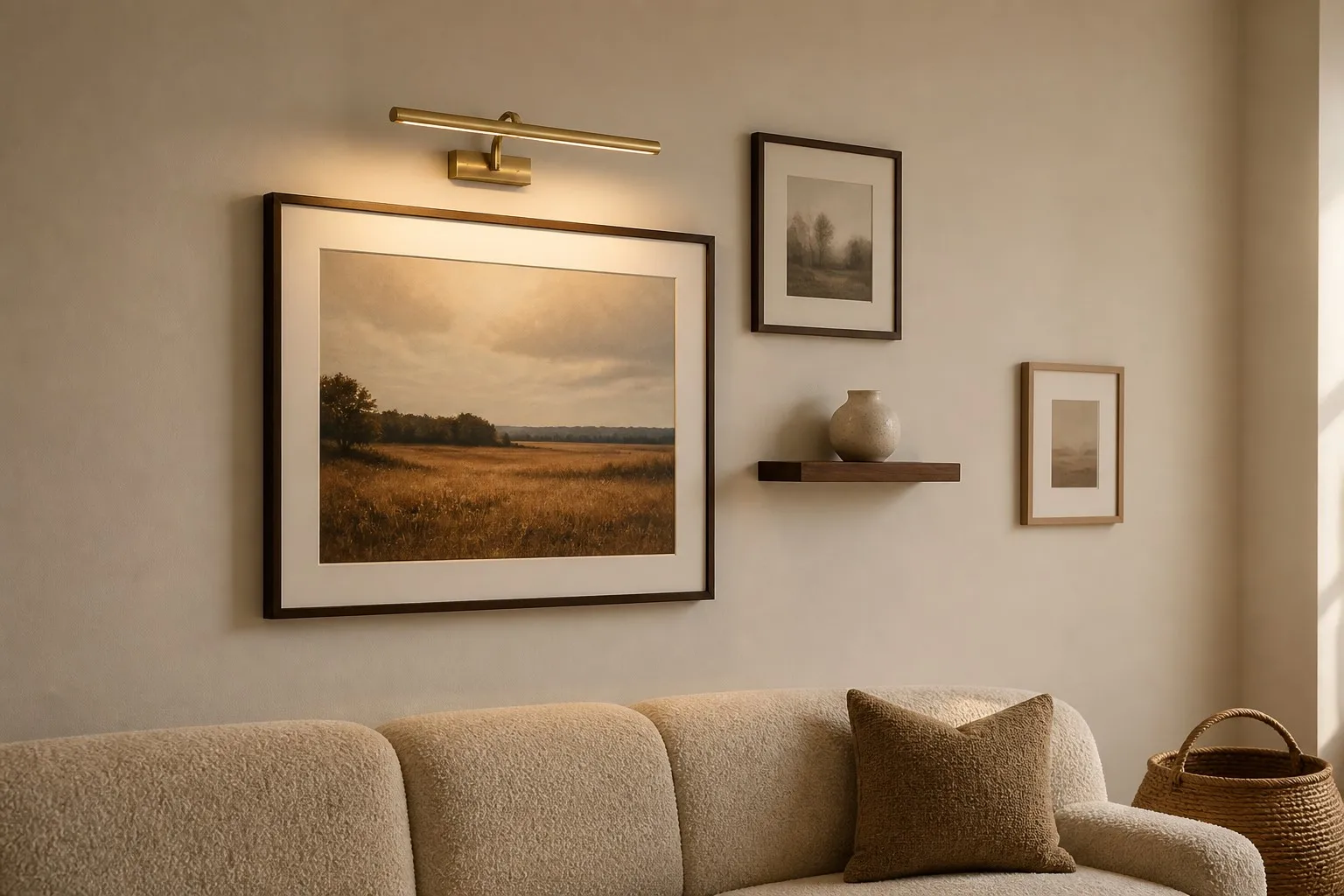
It looks effortless. It also looks hard to pull off — and once you've nailed the layout, there's a second problem almost no one plans for: how to light an off-center display without turning your living room into a showroom.
Why Asymmetric Works (and Grids Don't, Anymore)
Symmetry reads as formal and static; asymmetry reads as lived-in and intentional. The 2026 look borrows from gallery curation: one anchor piece doing the heavy lifting, smaller pieces "orbiting" it at varied distances, and the whole arrangement sitting slightly off the exact center of the wall. The trick is that the visual weight — not the physical center — is what has to balance.
The 3 Rules of an Off-Center Layout
- Anchor first. Pick your largest or boldest piece and place it slightly above eye level (about 60-63 inches to its center). Everything else relates to it, not to the wall.
- Work in odd numbers and uneven gaps. 3, 5, or 7 pieces read as curated; keep gaps between 2-4 inches but vary them slightly so it never looks templated.
- Balance "weight," not size. A big light frame can balance a small dark piece across the arrangement. When it feels off, you're usually one mat or one object away from balance — not one frame away.
Now Light It: Gallery Wall Lighting Ideas
Overhead cans wash the whole wall into flatness — fine for cleaning, terrible for an asymmetric display, because the pieces you want to emphasize get lost in the glare. Individual picture lights let you direct attention the way a curator does: light your anchor piece brightest, and let supporting pieces glow at the edges.
Two specs decide whether it actually looks good:
- Reach. An asymmetric wall mixes depths — frames, shadow boxes, small objects. A light that hugs the wall can't hit anything dimensional. Our Model 270 Wireless Picture Light extends on a telescopic arm, so you can pull it forward to light deep pieces and tuck it back for flat frames.
- Color accuracy. Mixed frames, mats, and artwork are the hardest thing an LED can show. Below CRI 90, whites go gray and wood tones go muddy; at CRI 90+, every material in the arrangement keeps its true color.
Renting? No Wiring, No Problem
The other reason asymmetric walls are everywhere in 2026: renters. You can't hardwire lights into a wall you don't own — and with a magnetic, rechargeable fixture you don't have to. Install in five minutes, reposition when the arrangement evolves (it will), and take everything with you when you move. For homeowners who want a permanent solution, our Hardwire Vision Series delivers the same museum-grade light with a clean built-in look.
The 60-Second Checklist
- Anchor at optical center, not wall center
- Odd numbers, uneven gaps, mixed depths
- Light the anchor brightest; let the edges glow
- Choose a light that reaches (telescopic arm) and one that renders color honestly (CRI 90+)
- No outlet near the wall? Rechargeable + magnetic wins
Make your wall look curated, not cluttered.
The Model 270 lights asymmetric displays the way a gallery would — CRI 90+, telescopic reach, magnetic no-drill mount.
Shop the Model 270Rechargeable · Magnetic Mount · CRI 90+ · Free Shipping over $35