

You have invested in a stunning piece of art, chosen the perfect frame, and hung it proudly on your living room wall. But when evening arrives and you turn on your room lights, something feels off. The upper portion of the canvas is shrouded in a dark shadow, the center has a blinding reflective glare, and the corners are lost in gloom.
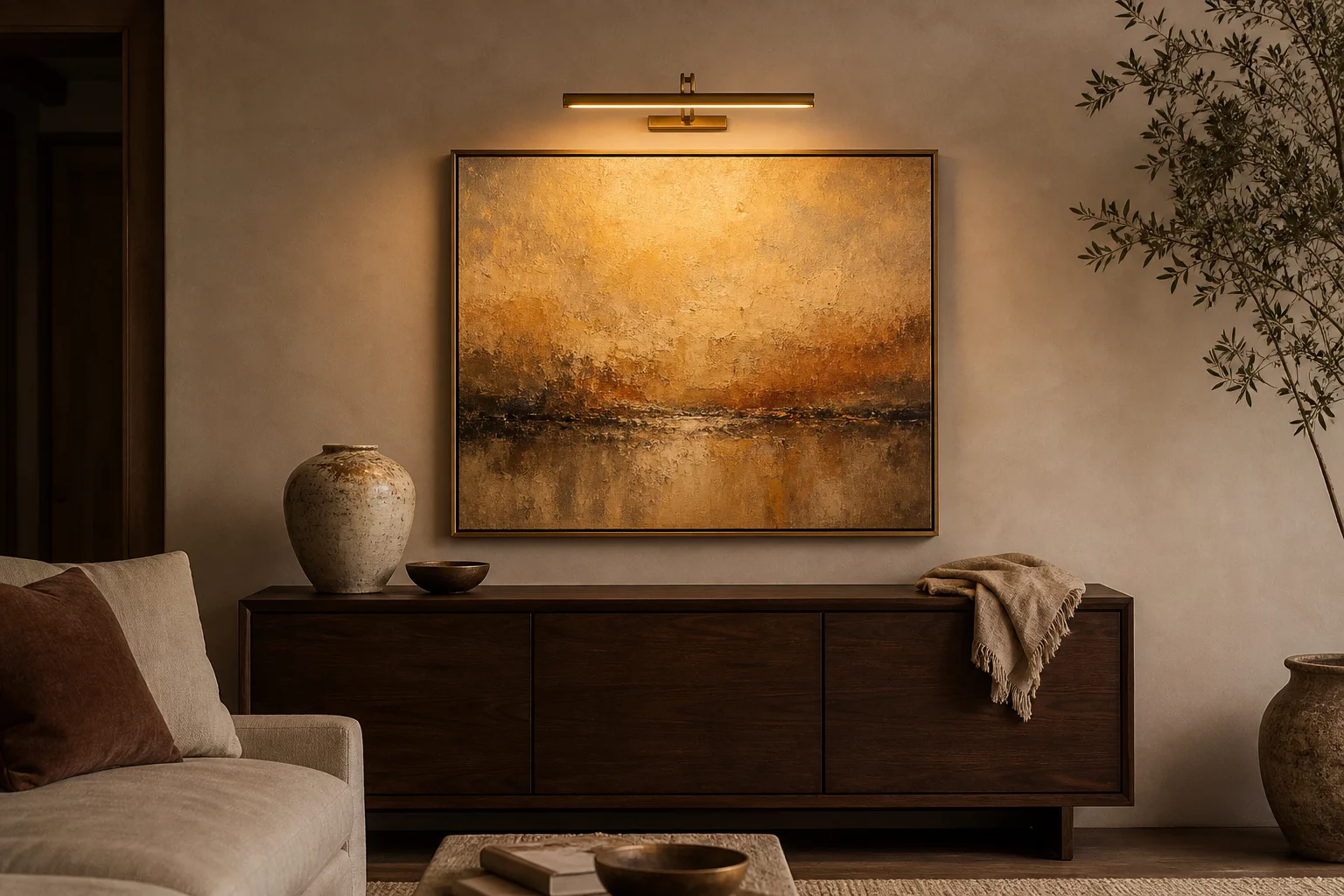
This is the classic pitfall of relying on recessed ceiling spotlights or track gimbals to illuminate wall art. While ceiling cans work well for ambient room illumination, their steep downward geometry creates optical distortions that can ruin even the finest artwork. Dedicated frame-mounted picture lights take a fundamentally different approach.
In this guide, we compare picture lights against ceiling spotlights across lighting geometry, shadow casting, beam distribution, and color accuracy—so you can make your art look like a museum centerpiece.
1. The Geometry of Glare: Incident Angles and Seated Eye Level
Basic optical physics dictates that the angle of incidence equals the angle of reflection. When a ceiling spotlight shines downward at a steep 45-degree angle toward framed art with glass or high-gloss varnish, the light bounces directly downward and outward—right into the eye level of anyone seated on a sofa or armchair.
A dedicated picture light mounts directly above the frame on an adjustable arm. Positioned just 5 to 8 inches off the wall, it casts light downward across the face of the canvas at a grazing angle. The reflected light bounces harmlessly down toward the floor, keeping the artwork completely glare-free from every viewing angle in the room.
2. Frame Shadows: The Top-Down Obstruction
Deep, ornate picture frames and shadowbox mouldings are popular because they add depth and luxury to artwork. However, when illuminated by an overhead ceiling light, the top lip of the frame acts as an awning—casting a heavy, harsh black shadow across the top 15% to 25% of your canvas.
Because an adjustable-arm picture light projects out past the front edge of the frame, the light source originates in front of the moulding. It completely eliminates top-frame shadow, illuminating the canvas evenly from the very top edge to the bottom border.
3. Beam Distribution: Circular Cones vs. Horizontal Optical Wash
Ceiling spotlights produce a circular or elliptical beam pattern. When aimed at a rectangular painting, this creates a bright "hotspot" circle in the center while leaving the outer corners underlit and muddy. Adjusting beam spread filters on ceiling tracks helps slightly, but rarely matches the true aspect ratio of a frame.
A cylindrical bar picture light houses a linear array of diffused LEDs. It produces a wide, uniform horizontal light curtain engineered specifically for rectangular frames, delivering balanced lumens from corner to corner.
4. Color Fidelity: Museum CRI 90+ vs. Builder-Grade Cans
Most residential recessed ceiling cans prioritize energy efficiency over color accuracy, typically offering a Color Rendering Index (CRI) between 75 and 82. Under low-CRI light, rich crimson reds, subtle ochres, and olive foliage appear flat and greyed-out.
The Seediq Model 270 Wireless Picture Light is engineered with studio-grade LEDs boasting CRI 90+ color rendering. Every pigment, metallic fleck, and textured brushstroke reflects with true-to-life depth and vibrancy.
5. Installation & Flexibility: The Cordless Advantage
Retrofitting ceiling spotlights requires cutting into attic spaces, patching drywall, and hiring licensed electricians—often costing $300 to $600 per light. Furthermore, if you ever decide to rearrange your furniture or hang a different size painting, the ceiling cans cannot easily move.
With magnetic, rechargeable mounting, the Model 270 installs in 5 minutes with zero wiring or ceiling damage. It delivers up to 80 hours of warm, dimmable 3-CCT illumination on a single USB-C charge, giving you complete freedom to curate your home art gallery whenever inspiration strikes.
Give Your Art the Gallery Illumination It Deserves
Experience the glare-free warmth of antique brass, museum-grade CRI 90+, and effortless magnetic mounting.
Shop the Model 270 Wireless Light