
Shopping for a picture light, one spec decides whether your art looks curated or clumsy — and it is the one almost no listing explains: size. Search "picture light" on Amazon and the refinements shoppers use most are measurements: 16 inch, 18 inch, 20 inch, 24 inch, even 36 inch. Buyers know length matters. The listings rarely help them solve it.
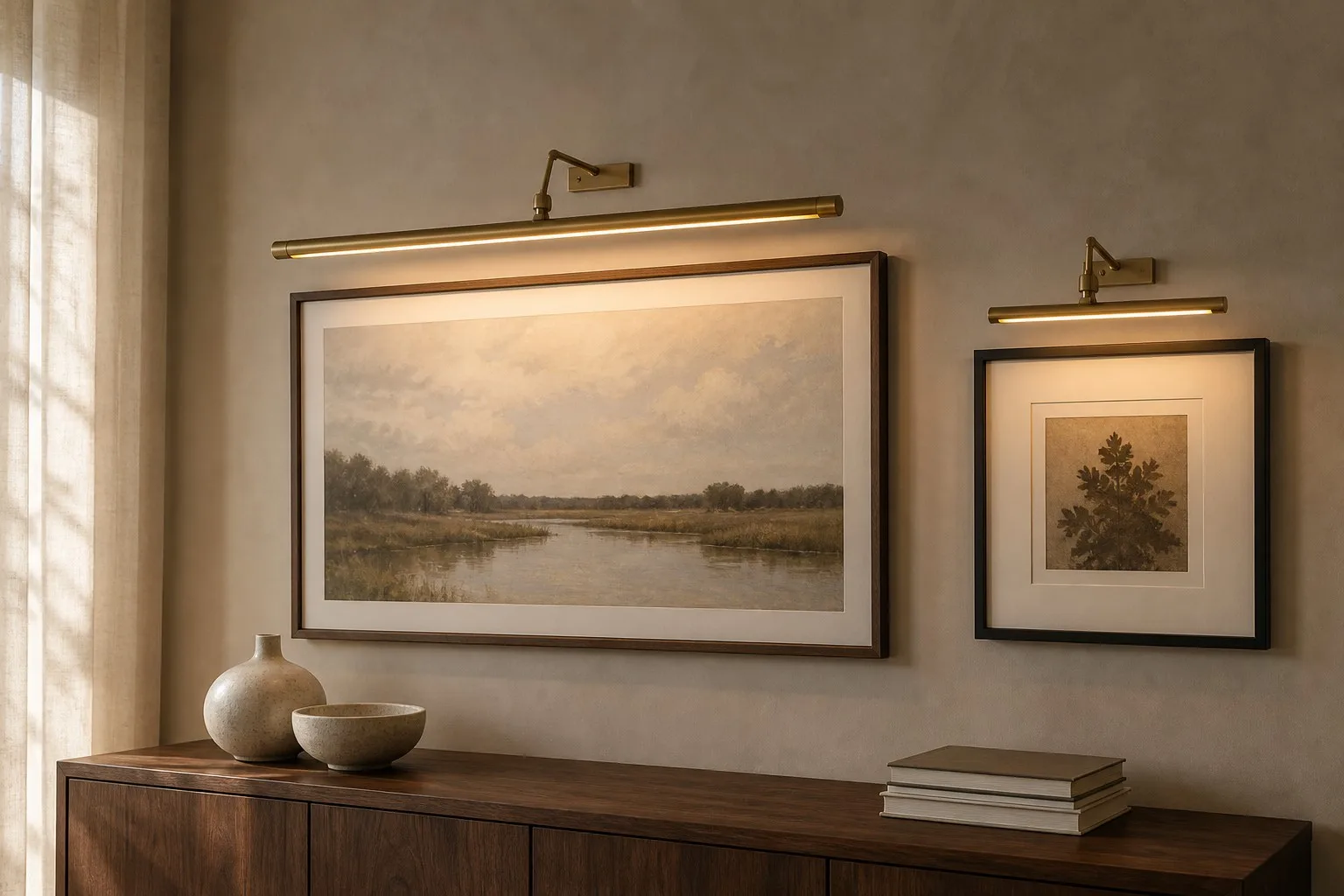
Here is a practical way to choose, using the same proportion rules gallery installers work with — plus what changes when you are lighting a whole wall instead of one frame.
The One Rule That Does Most of the Work
Match the lamp length to roughly half to two-thirds of the artwork's width. A light that is too short concentrates a hot spot in the middle and leaves the corners of the frame in shadow — the classic giveaway of an under-sized fixture. A light that is too long spills onto the wall and flattens the piece.
A quick reference for horizontal pieces:
- Up to 18" wide — an 8–12" lamp
- 18–30" wide — a 12–16" lamp
- 30–42" wide — a 16–20" lamp
- 42–60" wide — a 20–24" lamp
- Wider than 60" — a 32–36" lamp, or two lights spaced evenly
Tall or portrait-orientation pieces follow the same logic on their width, not their height — the light bar sits across the top edge, so its spread only needs to cover what it actually illuminates.
Height, Tilt and Throw: Where Small Details Show
Mount the light 6–8 inches above the top edge of the frame. Closer and the fixture glares into the artwork; higher and you lose the pool of light that makes the piece read as intentional.
Tilt matters too, especially with texture. Angling the head slightly forward throws a soft raking light that reveals canvas weave, brush texture, and dimensional objects — the same technique galleries use. This is also where reach becomes a real specification: a light mounted flat against the wall cannot properly illuminate a deep shadow box, floating shelf, or 3D piece. That is why we build the Model 270 with a telescopic arm that extends forward, so one fixture covers both flat frames and objects that stick out 4–5 inches.
Gallery Walls: How Many Lights Do You Actually Need?
For a collection of frames, resist the urge to light every piece equally. Give the anchor — your largest or boldest work — a properly sized lamp, then light one or two secondary pieces with shorter lamps of the same design. The eye follows the light, and uneven lighting is what makes an asymmetric arrangement feel deliberate rather than accidental.
For rows of frames, two or three matched lights read better than one very long bar, because each lamp can be angled to its own piece. Multi-packs exist for exactly this reason — and if you are buying for an entire wall, buying a matched set keeps the finishes and color temperature consistent, which matters more than most people expect.
Two More Specs That Decide Satisfaction
Color rendering. Mixed frames, mats, and materials punish cheap LEDs. A high CRI (Color Rendering Index) keeps wood grain warm and metal accents crisp instead of grey and washed out — look for CRI 90+ for artwork.
Installation. If you rent, size only matters if you can actually mount the light. A magnetic, no-drill mount installs in minutes and comes with you when you move; for permanent, professionally lit walls, our hardwired brass series is the equivalent long-term option.
60-Second Checklist
- Measure the art's width first, then pick a lamp at 50–65% of it.
- Mount 6–8" above the top edge; tilt slightly to bring out texture.
- Check the reach if you own deep frames, shelves, or 3D work — choose an adjustable or telescopic arm.
- Confirm CRI 90+ before buying, no matter how good the finish looks.
- For a full wall, buy a matched multi-pack so finishes and color temperature stay identical.
Right-sized light. Museum-grade color.
The Model 270 fits frames of any width — a telescopic arm for reach, CRI 90+ for true color, up to 80 hours per charge, and a magnetic mount that needs no wiring or drilling.
Shop the Model 270Rechargeable · Magnetic Mount · CRI 90+ · Free Shipping over $35